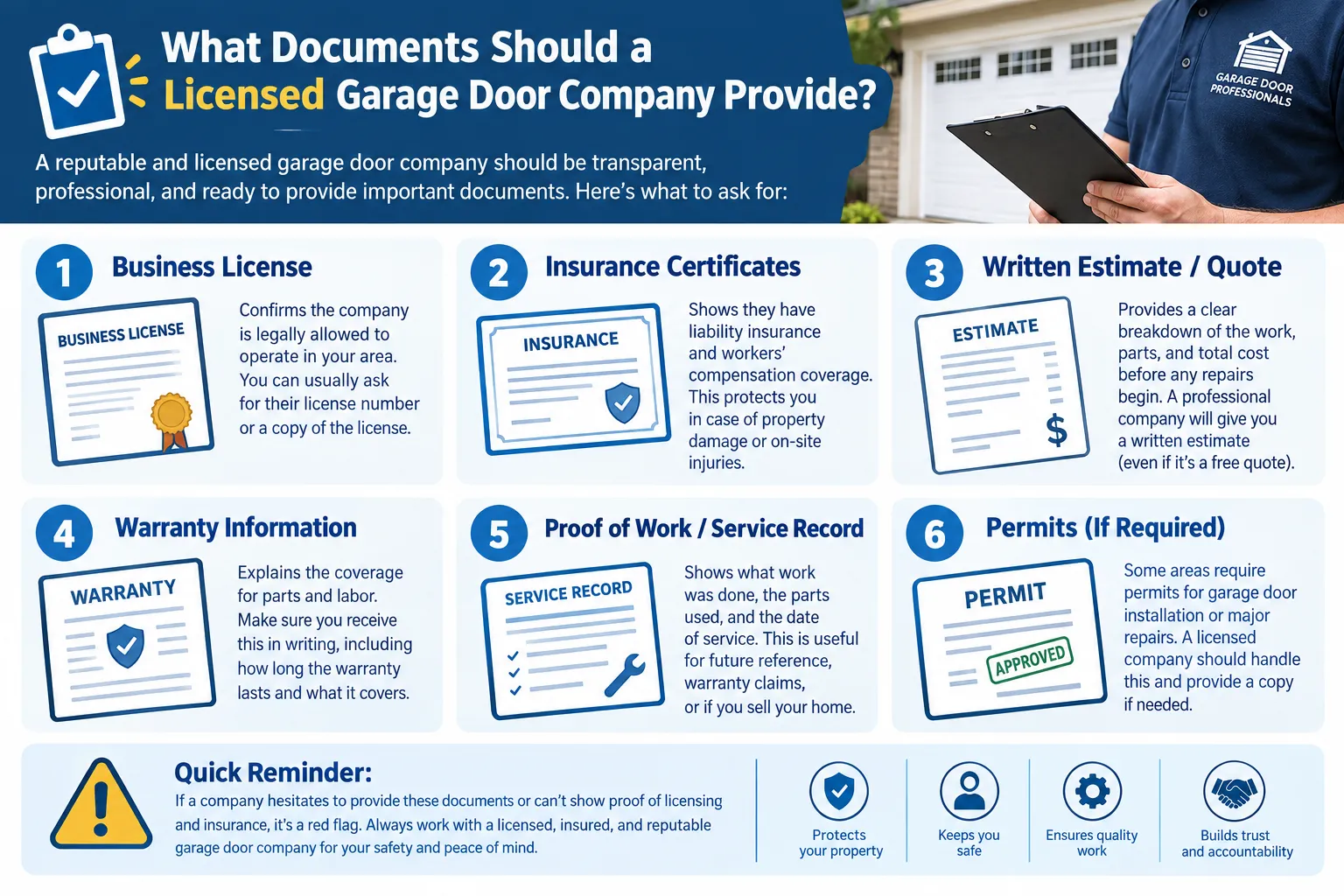
A licensed garage door company should always provide a written estimate, an insurance certificate, and proof of active licensing before any technician touches the property. These documents give a homeowner a clear paper trail if a dispute over a garage door repair ever comes up later.
Requesting this paperwork upfront takes only a few extra minutes but protects against months of frustration, unexpected repair costs, and legal exposure. This guide draws on years of industry experience to cover exactly which documents matter most, what each one confirms, and where to find them.
Key Takeaways
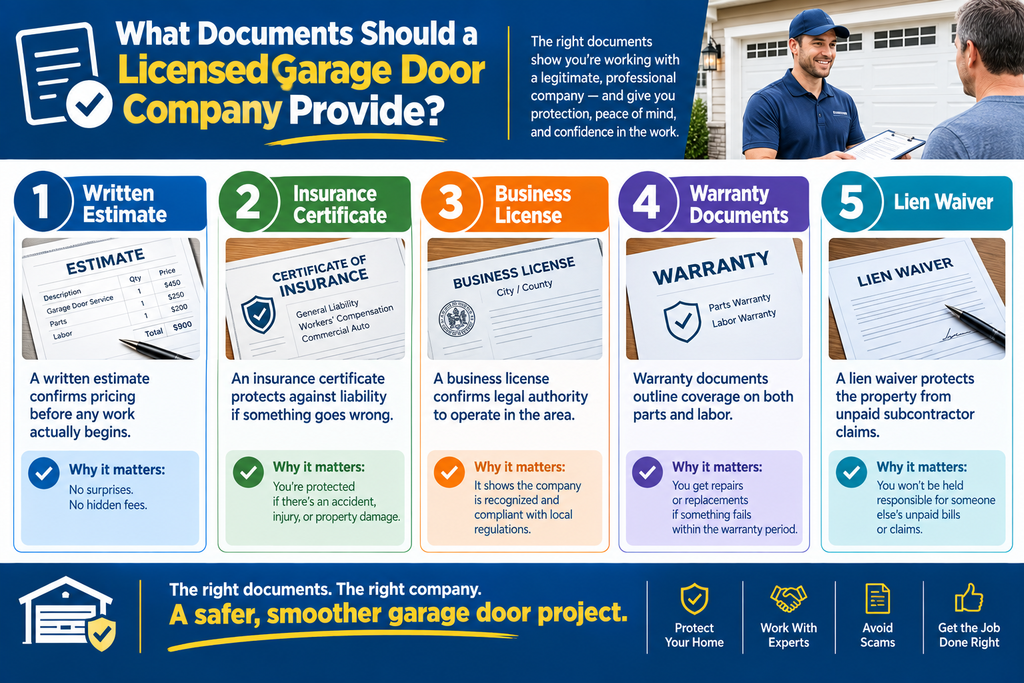
- A written estimate confirms pricing before any work actually begins
- An insurance certificate protects against liability if something goes wrong
- A business license confirms legal authority to operate in the area
- Warranty documents outline coverage on both parts and labor
- A lien waiver protects the property from unpaid subcontractor claims
Documents at a Glance
Proper documentation establishes the pricing, legal standing, and financial protection a homeowner should confirm before hiring any company.
| Document | What It Confirms | Where to Get It |
| Written estimate | Pricing agreed to before work begins | Provided directly by the company |
| Insurance certificate | Active coverage for liability and injury | Requested from the company’s office |
| Business license | Legal authority to operate | State or local licensing board |
| Manufacturer warranty | Coverage on specific parts | Included with new equipment |
| Lien waiver | Subcontractors paid in full | Signed by the company before final payment |
Missing even one of these documents leaves the homeowner without full financial and legal protection for the entire transaction.
Essential Pre-Work Documents
Written Estimate
Requesting a written estimate before hiring gives a homeowner a firm number to hold the garage door installation or repair against.
The document carries far more value when it spells out every line item clearly:
- The full labor cost broken out separately from every part charge listed
- Every applicable tax calculated in advance and shown as part of the running total
- A realistic timeline stating when the work is expected to begin and finish
- Payment terms explaining exactly when a deposit becomes due before work starts
- Contact information for the company matching the license number on file exactly
Comparing this estimate against the final invoice later becomes the fastest way to catch a discrepancy before paying anything.
Insurance Certificate
An insurance certificate proves the company carries active liability and workers’ compensation coverage during the job.
A valid certificate should clearly show the following details:
- The insurance carrier name and an active policy number
- Coverage limits that reflect the actual scope of the work
- An expiration date that has not already passed
- The business name matching exactly what appears on the estimate
- General liability coverage kept separate from vehicle insurance
Reviewing coverage details directly with the insurer before work begins closes a gap many homeowners overlook.
Business License
A business license confirms the company holds legal authority to operate as a door company in the local area.
This record can be checked through the following steps:
- Searching the state or local licensing board database directly
- Comparing the license number against the name on the estimate
- Confirming the license status shows active, not expired
- Calling the licensing board office if the record looks unclear
- Checking that the license type matches garage door work specifically
To pull up the exact steps for looking up this record against a company’s paperwork, read our guide on How to Verify a Garage Door Company License Number, which walks through the lookup process in full.
Service and Product Documents
Itemized Invoice
Line-item detail on an invoice makes it possible to check every individual charge against the original estimate that was provided.
Real value comes from an invoice that breaks the job down this clearly:
- Each individual part used, listed by name, model, and its exact unit cost
- Labor hours worked or a flat labor rate shown as its own separate line
- Any garage door replacement parts identified specifically by brand and model number
- The exact date the service took place, matching the scheduled appointment
- A grand total that lines up precisely with the number on the original estimate
Flag any mismatch between this invoice and the earlier estimate before paying for something that was never agreed to.
Manufacturer Warranty
A manufacturer warranty details exactly how long specific parts like springs, panels, and openers remain covered after installation.
Coverage terms worth confirming in writing include the following:
- The exact parts covered under the manufacturer warranty
- The length of coverage measured from the installation date
- Any conditions that could void the warranty later
- Contact information for filing a claim if needed
- Whether coverage transfers if the property changes ownership, and whether maintenance programs extend it further
To find out how a homeowner can judge whether a company stands behind claims like these once the job is finished, read our guide on How to Check Reviews for a Garage Door Company, which covers exactly what real feedback reveals.
Labor Warranty
A labor warranty is a direct pledge from the company to fix any installation error at no added cost for a clearly set period.
Terms worth reviewing before signing typically cover the following:
- The exact length of coverage after the job is finished
- Which specific labor mistakes qualify for a free fix
- Any exclusions that limit what the warranty actually covers
- The process for requesting a repair under warranty
- Contact details separate from general customer service lines
Homeowners who keep both warranty documents on file avoid confusion later about which one applies to a problem with the main door or its opener.
Completion Documents
Receipt of Payment
Holding onto proof of payment protects a homeowner if an unexpected billing question ever comes up several months down the road.
Real protection comes from a receipt that documents these specific details:
- The exact dollar amount paid and the specific payment method used
- The precise date the company received the full payment
- A reference number that matches the number on the original invoice
- The business name and address appearing exactly as shown on other paperwork
- Clear confirmation stating the remaining balance owed has reached zero
Keeping this receipt on file becomes valuable if a billing dispute surfaces during a future garage door maintenance visit.
Lien Waiver
A lien waiver protects the property from a subcontractor or supplier who was not paid directly by the main company.
Homeowners should request a lien waiver that confirms the following:
- The exact project address covered under the waiver
- Confirmation that all subcontractors received full payment
- The date the waiver was signed relative to job completion
- A signature from an authorized company representative
- Language specifying the waiver covers the full project scope at the agreed lower cost
To review the complete picture of what protects a homeowner across the entire hiring process, read our guide on How to Confirm a Legitimate Garage Door Company, which covers every step from start to finish.
Cross-Checking Every Document Closes the Final Gap
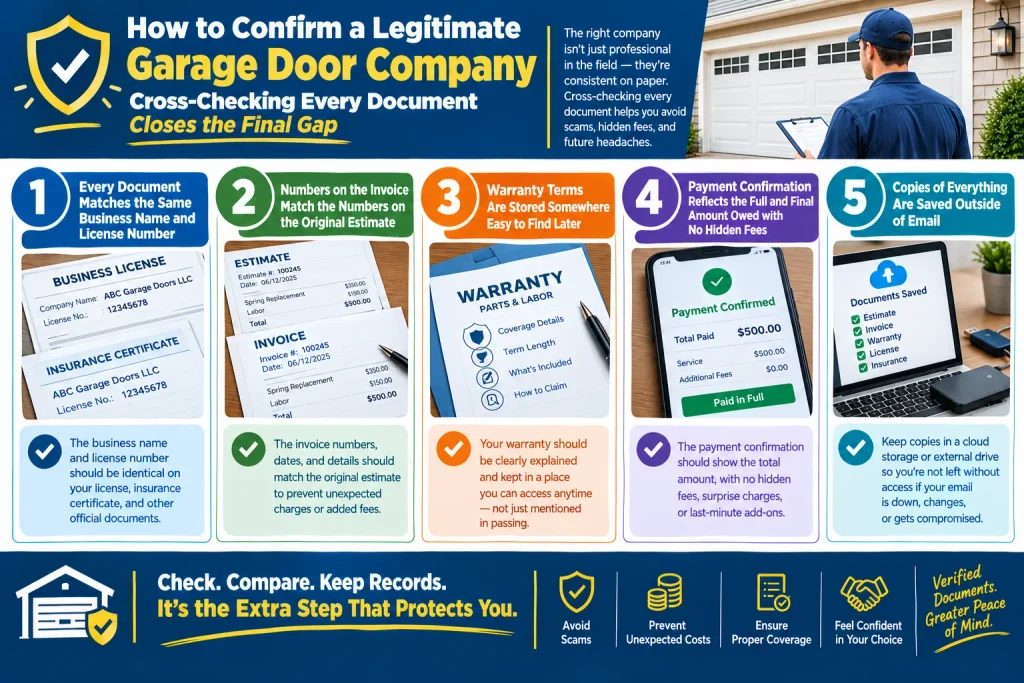
A homeowner holding every document covered above has real proof the company followed through on every promise made before the job started.
This final review typically involves confirming the following:
- Every document matches the same business name and license number
- Numbers on the invoice match the numbers on the original estimate
- Warranty terms are stored somewhere easy to find later
- Payment confirmation reflects the full and final amount owed with no hidden fees added late
- Copies of everything are saved outside of email in case access changes
A homeowner who reaches this point has already avoided the paperwork gaps behind most garage door scams reported across the industry.
Complete Documentation Protects Every Garage Door Job From Start to Finish
Requesting these documents upfront turns an uncertain hiring decision into a transaction built on transparent pricing and a fair price for the work performed. A company willing to provide each one without hesitation is already showing the transparency you should expect for the rest of the job.
Alachua Door Company provides every document covered in this guide to Gainesville homeowners as standard practice during regular business hours. Contact us or give us a call today, and let a technician walk through this exact paperwork before the first tool comes out.
Frequently Asked Questions
Why does an insurance certificate matter when hiring a garage door company?
An insurance certificate proves the company carries active coverage for property damage or worker injury that might occur during the job. Homeowners should confirm the certificate lists an active policy number and an expiration date that has not passed.
How can a homeowner confirm a business license is valid?
Searching the state or local licensing board database directly confirms whether a license number is active and tied to the correct company name. Calling the licensing board office directly clears up any unclear online records.
What is the difference between a manufacturer warranty and a labor warranty?
A manufacturer warranty covers specific parts like springs or openers, while a labor warranty covers mistakes made during new garage door installations. Keep both documents on file since they cover different aspects of the same job.
Why is an itemized invoice more useful than a single total charge?
An itemized invoice lists every part and labor charge separately, making it much easier to compare against the original written estimate. If a total doesn't match the earlier estimate on a garage repair job, it's worth questioning before you pay.
What is a lien waiver and why does it matter?
A lien waiver confirms that subcontractors or suppliers involved in the job received full payment directly from the company. This document protects the property by creating a paper trail, not just the door itself.
How long should a homeowner keep these documents on file?
Keeping copies of every document for at least a year covers most warranty periods and gives a homeowner a paper trail if a dispute comes up. Storing copies outside of email protects against losing access if an account changes.
What happens if a company refuses to provide a written estimate?
A company unwilling to provide a written estimate before starting work should raise immediate concern about the rest of the job. This reluctance is one of the clearest signs to watch for, whether the appointment is for routine work or the best repair option available.
Does a receipt of payment protect against future disputes?
A receipt of payment confirms the exact amount paid, the payment method, and the date the balance reached zero. This document becomes especially useful if a broken garage door issue resurfaces and you need proof of payment for a warranty claim.
Can a homeowner request these documents after the job is already finished?
Requesting documentation after the fact is possible, but getting everything in writing before the job starts remains the safer approach. A trustworthy new door company keeps records on file and provides copies without hesitation whenever asked.