A garage door that stops responding to the opener means manual mode is the only way forward, and knowing how to put a garage door in manual mode is what keeps you in control when the system fails. Understanding the emergency release mechanism is the first step before attempting to disengage the door.
Pulling the wrong cord or skipping inspection steps is what turns a simple manual override into a costly garage door repair call. This guide covers the manual mode process, what to check before you start, how to close garage door manually, and when the job needs a trained technician.
What Does It Mean to Put a Garage Door in Manual Mode?
Putting a garage door in manual mode means disconnecting it from the automatic opener so the door can be moved by hand, and it is the most reliable option when the automatic system fails or power is unavailable.
Key things to understand about manual mode include:
- Pulling the emergency release cord separates the trolley from the opener carriage.
- Power stays on, but the opener loses all control over the door’s movement.
- Torsion springs carry the full weight of the door once the opener is disengaged.
- Manual mode is temporary until the opener issue is resolved.
- It works the same way regardless of whether the opener has a fault or the power is out.
To understand the full process for operating a garage door without an automatic opener, read our guide on How to Close a Garage Door Manually, which walks through every step a homeowner needs to take when the automatic system is no longer an option.
When Should You Switch Your Garage Door to Manual Mode?
Switching to manual mode becomes necessary when the automatic system can no longer respond to commands.
Common situations that require switching to manual mode include:
- A power outage cuts off electricity to the opener, making remote or wall-switch operation impossible.
- The garage door won’t close automatically due to a fault in the opener’s internal components.
- An emergency requires the door to be secured immediately without waiting for power.
- A malfunctioning opener keeps running but fails to move the door in either direction.
- A power surge disables the electric opener without any warning.
To find out what steps to follow when you need to close garage door without power, read our guide on Can I Close My Garage Door With No Power?, which covers everything a homeowner needs to know when electricity is not available.
Parts to Check Before Switching to Manual Mode
Inspecting the right components before switching to manual mode confirms that the door is in a condition that allows safe and smooth manual operation.
Important parts to check before switching to manual mode include:
- The red emergency release cord must be intact, visible, and hanging freely from the trolley.
- Torsion springs above the door should have no visible gaps or breaks in the coil.
- Cables on both sides must be taut, unfrayed, and properly seated on the drums.
- Tracks should be free of bends, dents, and debris that could block movement.
- Rollers must be intact and able to glide without grinding or resistance.
A quick inspection of these parts may reveal damaged components that need garage door spring repair before manual operation is attempted.
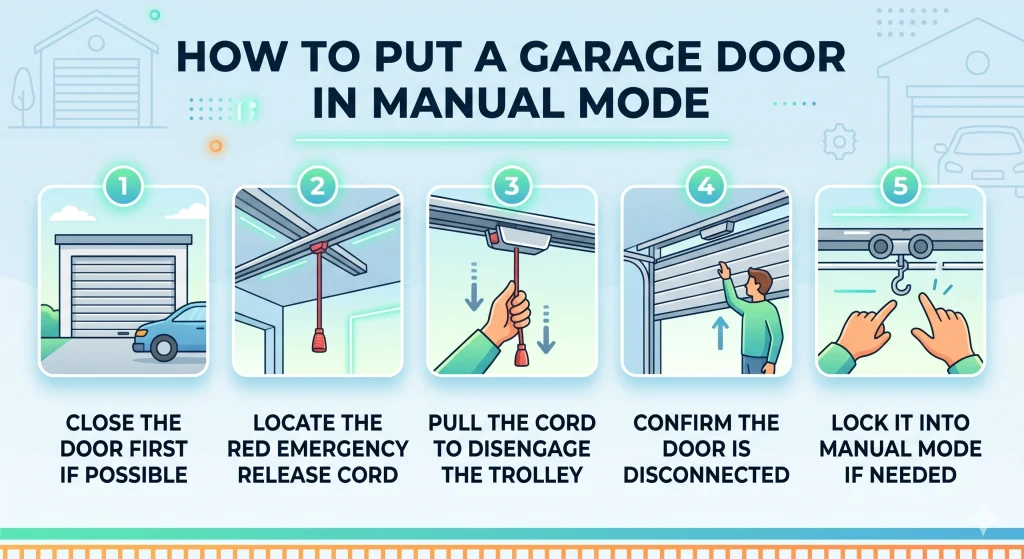
Steps to Put Your Garage Door in Manual Mode
Step 1: Close the Door First if Possible
Closing the door before disengaging the opener gives you the most control when switching to manual mode.
What to do before pulling the release cord:
- Use the remote or wall button to fully close the door before touching anything else.
- If the garage door won’t close automatically, be prepared to support the door’s weight manually.
- Make sure no one is standing under or near the door before proceeding.
- Confirm the door is fully down and sitting flush with the ground.
- Never pull the release cord while the door is still moving in either direction.
A door that refuses to close using the remote or wall button may already have an underlying issue worth inspecting before proceeding.
Step 2: Locate the Red Emergency Release Cord
Finding the red emergency release cord quickly makes manual garage door operation go smoothly from the start.
How to find the emergency release cord:
- Look up at the center rail running through the middle of the garage ceiling.
- Find the red handle hanging down from the trolley along the rail.
- Use a flashlight to close garage door without power when the garage has no natural light.
- Make sure you are reaching for the red cord, not any other nearby wires.
- Confirm the cord is intact and the red handle is fully attached before pulling.
A frayed, missing, or hard-to-reach cord is a sign that the garage door system needs attention before an emergency arises.
Step 3: Pull the Cord to Disengage the Trolley
Pulling the red emergency release cord in the correct direction fully separates the door from the automatic opener carriage.
How to pull the cord correctly:
- Grip the red handle firmly with one hand before pulling.
- Pull the cord straight down toward the ground for the most effective disengagement.
- Listen for a click or pop that confirms the trolley has separated from the carriage.
- Avoid pulling at an angle, as this may cause incomplete disengagement.
- Do not force the cord if it feels stuck, as this can damage the manual release mechanism.
Incomplete disengagement after pulling the cord indicates a worn trolley that may require garage door roller replacements before manual operation can resume.
Step 4: Confirm the Door Is Disconnected
Verifying full disconnection before moving the door prevents unnecessary strain on the opener and mechanical components.
How to verify the door is fully disconnected:
- Lift the door a few inches by hand to test whether it moves freely.
- Check for a visible gap between the trolley and the opener carriage.
- Run the opener to confirm it activates without moving the door.
- An emergency garage door manual close situation requires this confirmation before anything else.
- Never attempt to move the door fully if it still feels locked to the carriage.
A door that still feels connected after pulling the cord may have a trolley or carriage issue that requires a closer inspection by a professional technician.
Step 5: Lock It Into Manual Mode if Needed
Locking the trolley in the disengaged position keeps the door in manual mode without requiring you to hold the cord.
How to lock the door in manual mode:
- Pull the red handle back toward the motor to lock the trolley in place.
- Check whether the trolley stays disengaged without holding the cord.
- Look for a built-in hook or catch near the trolley that holds the release in position.
- Consult the opener manual if the locking step is unclear for your specific model.
- Manual garage door closing requires the trolley to stay locked until the issue is resolved.
A trolley that refuses to stay locked points to worn internal components that a professional garage door technician should inspect.
How to Close a Garage Door Manually After Disengaging the Opener
Once the opener is disengaged, knowing how to manually close a garage door ensures the door is fully secured without damaging the panels or hardware.
Key steps to close a garage door manually after disengaging the opener:
- Grip the door handle or bottom panel firmly with both hands before lowering.
- Lower the door slowly and evenly to keep the rollers inside the track on both sides.
- Guide the door all the way down until it sits flush with the ground.
- Engage the manual lock bar or slide bolt to secure the door in the closed position.
- Use a zip tie on the emergency release cord to prevent it from being pulled from outside.
Learning how to shut garage door manually comes down to controlling the door’s movement and securing it properly once it reaches the closed position.
How to Reconnect Your Garage Door to the Opener After Manual Mode
Method 1 — Using Your Remote to Re-Engage
Pressing the remote after restoring power is the fastest way to reconnect the door to the automatic opener carriage.
What to expect when using the remote to re-engage:
- Press the remote and listen for the motor to activate along the rail.
- Watch the carriage move toward the trolley until both connect with a click.
- Confirm the door opens and closes fully using the remote before relying on it again.
- Stand clear of the door during the first test to make sure it moves without resistance.
- Repeated failed attempts using the remote point to a carriage or trolley issue.
Persistent failure to re-engage using the remote is a sign that the automatic opener needs a professional inspection.
Method 2 — Pulling the Red Handle Toward the Door
Pulling the red handle in the opposite direction from disengagement resets the lock mechanism and prepares the trolley to reconnect with the carriage.
How to pull the red handle to re-engage:
- Locate the red handle hanging loosely from the trolley after manual mode.
- Pull the handle firmly toward the front of the garage, away from the motor.
- Feel for the spring inside the trolley contracting as the handle moves forward.
- Try operating the door with the remote immediately after pulling the handle.
- Repeat the pull if the trolley does not catch the carriage on the first attempt.
Failure to reconnect after pulling the handle toward the door points to a worn spring inside the trolley that a professional technician should inspect.
Method 3 — Manually Moving the Door Until It Clicks
Manually raising or lowering the door until the trolley snaps back into the carriage is the most reliable fallback when the first two methods fail.
What to do when manually moving the door to reconnect:
- Lift the door slowly toward the open position while listening for a click.
- Lower the door back down if no click occurs during the upward movement.
- Try the remote after each attempt to check whether the door has reconnected.
- Move the door at a steady pace to give the trolley enough time to catch the carriage.
- Stop immediately if the door feels uneven or produces grinding sounds during movement.
A door that consistently refuses to reconnect after multiple attempts needs a professional garage door technician to assess the trolley and carriage components.
Common Problems When Operating Your Garage Door in Manual Mode
Manual operation does not always go smoothly, and knowing what to look for helps you respond without making the situation worse.
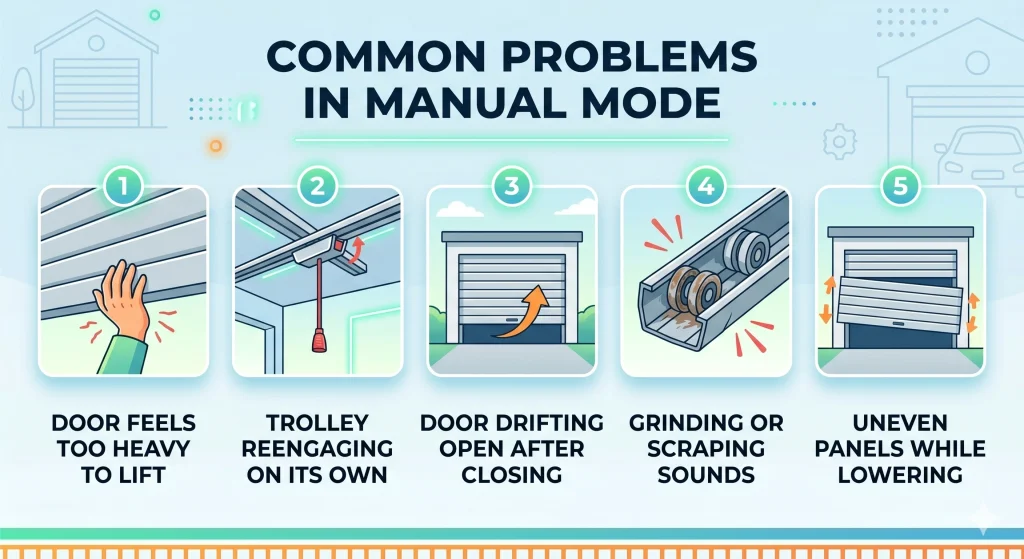
Common problems when operating a garage door in manual mode include:
- A door that feels too heavy to lift usually means a broken spring or a snapped cable.
- Trolley re-engaging on its own means the release cord was not pulled far enough back.
- The door drifting open after closing points to springs that are too tightly tensioned.
- Grinding or scraping sounds indicate worn rollers or bent tracks.
- Uneven panels, while lowering, mean the door is no longer properly balanced.
To learn more about the causes of these issues and how to address them, read our guide on Why Won’t My Garage Door Close Manually?, which covers every reason a garage door struggles during manual operation and what needs to be done about it.
When to Call a Professional for Your Garage Door Manual Mode Issues
Certain manual mode issues go beyond what a homeowner can handle, and calling a professional is the only option.
Signs that require a professional for garage door manual mode issues:
- Broken torsion spring or snapped cable on either side of the door.
- Bent or misaligned tracks are blocking the door’s movement.
- A trolley or carriage that refuses to reconnect after multiple attempts.
- Persistent opener malfunctions after reconnecting to the carriage.
- Bent or cracked panels affecting the door’s full range of motion.
Attempting to fix these issues without proper training can worsen the problem and may call for garage door panel repair or full component replacement.
Switching Your Garage Door to Manual Mode Is a Skill Worth Mastering Before an Emergency Hits
Knowing how to put a garage door in manual mode gives you the control to keep your home protected when the opener fails, the power goes out, or the system breaks down without warning. Manual mode is a valuable short-term solution, but restoring your garage door to full automatic operation is what keeps your home running the way it should.
Alachua Door Company proudly serves homeowners across Gainesville, FL with professional garage door repair, maintenance, and installation services. Contact us or give us a call today so our licensed technicians can diagnose the cause of your garage door switching to manual mode and get it working properly again.
Frequently Asked Questions
Can I put a heavy garage door in manual mode by myself?
Yes, but garage door manual operation on a heavier door requires more physical effort, especially if the torsion springs are worn or the door is not properly balanced. Having a second person present makes the process easier and more controlled.
What happens if I pull the wrong cord while trying to switch to manual mode?
Pulling the wrong cord will not disengage the trolley and may interfere with the opener's wiring or other components. Always locate the red handle specifically, as it is the only cord connected to the manual release mechanism.
Why does my garage door feel uneven when I try to manually lower garage door?
An uneven feel during manual lowering usually indicates a worn cable, a damaged roller, or a bent track on one side of the door. A professional technician should inspect the door before you attempt to operate it manually again.
Is it normal for the garage door to make noise when switching to manual mode?
Yes, a click or pop sound when pulling the release cord is completely normal and simply means the trolley has separated from the opener carriage. Any grinding, scraping, or loud banging sounds are not normal and should be inspected by a professional.
Can the garage door won't close automatically be resolved by switching to manual mode?
No, switching to manual mode is a temporary workaround and does not fix the underlying reason the garage door won't close automatically. A professional technician needs to diagnose the opener, sensors, or mechanical components to restore automatic operation.
How long does it take to put a garage door in manual mode?
Putting a garage door in manual mode takes less than a minute when the steps are followed correctly. Locating the red emergency cord hanging from the trolley system and pulling it straight down is all it takes to disengage the door from the automatic door opener.
Does putting a garage door in manual mode affect the opener's settings or programming?
No, switching to manual mode does not erase or alter the opener's programming or remote control settings. Once the door is reconnected to the carriage, the automatic garage door opener resumes normal operation without any reprogramming needed.
How do I know if my garage door opener is compatible with manual mode operation?
Almost all residential garage door openers manufactured in the United States come with a built-in manual release mechanism as a standard safety feature. If your opener does not have a visible red emergency release cord, contact the manufacturer or a professional technician to confirm whether manual mode is available on your specific model.
What should I do if the red emergency release cord is missing or has been removed?
Contact a professional garage door technician immediately, since operating the door without a functional release cord leaves you without a way to disengage the opener during an emergency. A technician can assess whether the cord needs to be replaced or if the entire manual release mechanism requires attention.