

A garage door that stops working during a power outage leaves your home exposed until you figure out how to close it. Determining whether you can close your garage door without power depends on the door’s condition, where you are standing, and whether the manual release is accessible.
Forcing the door shut without knowing what to check first can cause more damage and leave you needing a garage door repair sooner than expected. This guide covers when closing your garage door without power is possible, when it is not, and what Gainesville, FL, homeowners need to know before touching the emergency release cord.
What Happens to Your Garage Door When the Power Goes Out?
Losing power affects your garage door in ways that go beyond just losing remote access, and understanding how the system behaves during an outage helps you respond without making things worse.
When the power goes out, here is what happens to your garage door:
- The automatic opener loses power and stops receiving signals from your remote control.
- The door stays frozen in whatever position it was in when power was cut.
- The wall button and remote control become completely unresponsive.
- Garage door sensors go offline and stop detecting movement or obstructions.
- The automated opener disconnects from its normal cycle until power is restored.
To understand what these changes mean for your ability to operate the door by hand and what to do about it, read our guide on How to Close a Garage Door Manually, which covers the full manual operation process from start to finish.
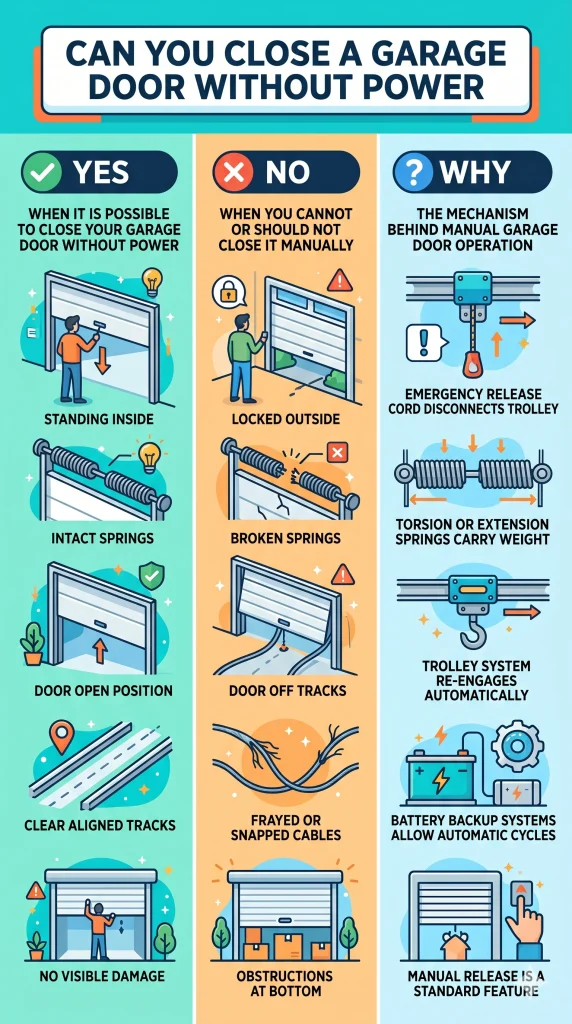
Can You Close a Garage Door Without Power?
Yes — When It Is Possible to Close Your Garage Door Without Power
Closing your garage door without power is achievable when specific conditions inside the garage are met before attempting manual operation.
Situations where closing your garage door without power is possible include:
- Standing inside gives you direct access to the emergency release cord.
- Intact springs keep the door weight manageable during manual lowering.
- The door in the open position allows for a clean, unobstructed manual descent.
- Clear and aligned tracks let the door travel down without resistance.
- No visible damage to panels, cables, or hardware means the door is workable.
Doors that meet all of these conditions are generally the easiest and most straightforward to close manually during a power outage.
No — When You Cannot or Should Not Close It Manually
Recognizing conditions that make manual operation unsafe is just as important as knowing how to close garage door manually.
Situations where closing your garage door manually is not an option include:
- Being locked outside makes the emergency release cord completely unreachable.
- Broken springs leave the full door weight unsupported and dangerous to move.
- The door off its tracks makes any manual movement a risk for further damage.
- Frayed or snapped cables signal that the door has lost its balance.
- Obstructions at the bottom of the door prevent manual lowering entirely.
Attempting manual operation under any of these conditions turns a manageable situation into one that requires emergency garage door repair.
Why — The Mechanism Behind Manual Garage Door Operation
Understanding the mechanics behind manual garage door closing gives homeowners a clearer picture of how the process works.
Key mechanical factors that make manual garage door operation possible include:
- The emergency release cord disconnects the door from the trolley, allowing it to move independently of the motor.
- Torsion or extension springs carry the door weight, making manual lowering manageable.
- Trolley system re-engages automatically once power returns and the door is repositioned.
- Battery backup systems allow limited automatic cycles even during a full power outage.
- Manual release is a standard feature built into every residential garage door with an electric opener.
Every one of these components, working together, is what makes an emergency garage door manual close a viable option for most homeowners when the power goes out.
Safety Checks Before Closing Your Garage Door Manually
Running a quick inspection before touching the emergency release cord helps keep a routine manual operation from turning into a bigger problem.
Safety checks to complete before closing your garage door manually include:
- Inspect the springs for visible gaps or breaks before attempting any manual movement.
- Check cables for fraying, looseness, or signs of snapping along the lift path.
- Look along both tracks for debris, dents, or sections pulling away from the wall.
- Confirm the tracks are parallel and evenly spaced from top to bottom on both sides.
- Clear the floor of objects, vehicles, and people before pulling the release cord.
- Test the door’s balance by lifting it slightly to feel whether the springs support its weight.
- Make sure you have enough light to see what you are working with before proceeding.
To get a full breakdown of what disengaging your opener actually involves, read our guide on How to Put a Garage Door in Manual Mode, which walks through the disengagement process in detail.
How to Close Garage Door Without Power Safely
Knowing how to shut garage door manually during a power outage comes down to following the right sequence of steps before and after pulling the emergency release cord.
Steps to close your garage door without power include:
- Locate the red emergency release cord hanging from the center rail above the door.
- Pull the cord firmly downward until you feel the trolley disconnect from the carriage.
- Grip the door with both hands and lower it slowly to the closed position.
- Guide the door all the way down until it sits flush against the floor with no gaps.
- Engage the manual bolt lock on the inside of the door to keep it secured.
If the opener fails to respond after re-engagement, garage door installation or replacement of the opener may be the next logical step.
Why Some Garage Doors Are Harder to Close Manually
Garage doors that feel heavy or resistant during manual operation are usually dealing with underlying mechanical conditions that have built up over time.
Reasons why some garage doors are harder to close manually include:
- Worn or broken springs remove all counterbalance support, putting full door weight on you.
- Misaligned or bent tracks create friction, making it a struggle to lower the door.
- Frayed or loose cables throw off the door balance and make controlled movement difficult.
- Debris or rust inside the tracks slows the rollers and causes uneven travel.
- A damaged trolley that did not fully disengage keeps the door partially locked to the opener.
To find out what each of these issues means for your door’s long-term condition and what steps to take next, read our guide on Why Won’t My Garage Door Close Manually?, which covers every common cause in detail.
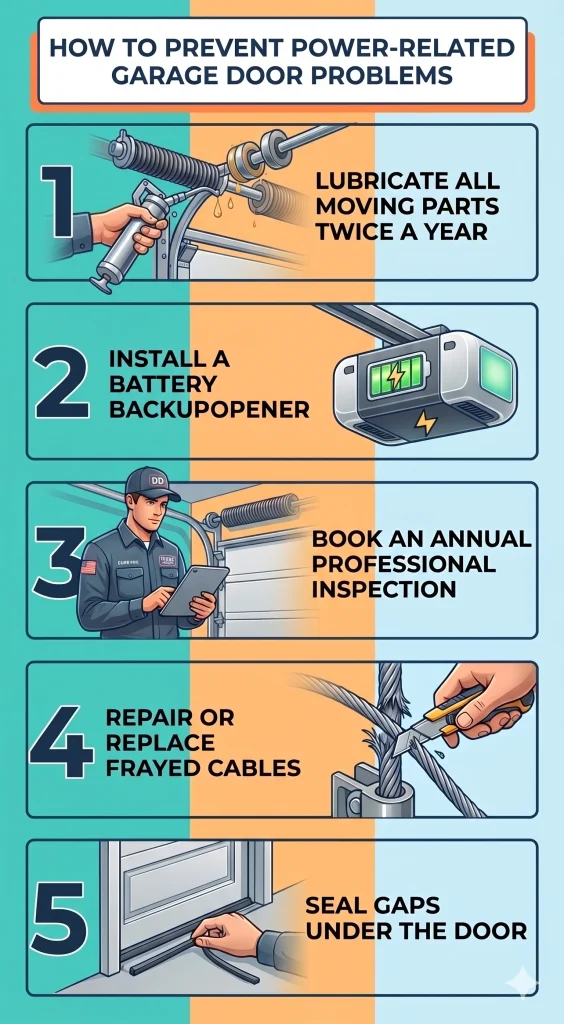
How to Prevent Power-Related Garage Door Problems in Gainesville, FL
Power-related garage door problems are almost always preventable when the right maintenance habits are in place before an outage occurs.
Ways to prevent power-related garage door problems include:
- Lubricate all moving parts at least twice a year to reduce friction and wear.
- Test the emergency release cord every few months to confirm it disengages cleanly.
- Disconnect the opener and lift the door to waist height to check the balance regularly.
- Install a battery backup opener to keep the door operational during outages.
- Book an annual professional inspection to catch mechanical issues early.
Regular maintenance is the most direct way to make sure power-related problems never catch your garage door off guard.
Can Your Garage Door Close Without Power? We Have the Answer and the Fix
Knowing whether you can close your garage door with no power gives you the confidence to protect your home when an outage hits without warning. Manual operation is a valuable short-term solution, but restoring your garage door to full automatic operation is what keeps your home secure the way it should be.
Alachua Door Company proudly serves homeowners across Gainesville, FL with professional garage door repair, maintenance, and installation services. Contact us or give us a call today so our licensed technicians can assess your garage door, identify what is preventing it from operating properly, and get it working reliably again.
Frequently Asked Questions
Will my garage door stay closed on its own after I lower it manually?
No, the opener's automatic locking feature does not work when the door is in manual mode. You need to engage the manual slide bolt lock on the inside of the door to keep it secured after you manually lower garage door.
How do I know if my garage door is safe to close manually during a power outage?
Check the springs, cables, and tracks before attempting anything. If the springs look intact and the cables are tight, garage door manual operation is generally manageable for most homeowners without professional help.
What type of garage door opener works during a power outage without going manual?
Openers with a built-in battery backup system can still operate automatically for a limited number of cycles during an outage. Without a battery backup, the only way to close the door is to learn how to manually close a garage door using the emergency release cord.
Can I damage my garage door opener by using the emergency release too often?
Yes, frequent use of the emergency release without properly re-engaging the trolley puts unnecessary stress on the release mechanism over time. Using it only when necessary and re-engaging it correctly after every manual operation keeps the opener in good condition.
What should I do if my garage door won't close automatically after power is restored?
Check that the trolley is fully re-engaged with the carriage before testing the opener again. In many cases, a garage door won't close automatically after a power outage simply because the emergency release was never re-engaged after manual operation.
Is it possible to lock my garage door from the outside when it is in manual mode?
Yes, but only if your garage door has an exterior keyed lock or an emergency release lock cylinder installed at the top of the door. Without one of these features, the door cannot be locked from the outside while in manual mode.
How do I re-engage my garage door opener after using manual mode during a power outage?
Pull the emergency release cord back toward the motor or lift the door to the open position until the trolley snaps back into the carriage. Once re-engaged, test the opener with your remote control to confirm automatic mode is restored.
Does the door's weight affect how easy it is to close manually?
Yes, the spring condition is the biggest factor in how manageable the door feels during manual operation. Worn or broken springs remove all counterbalance support, making it significantly harder to safely and evenly lower the door by hand.
What is the difference between an emergency release cord and an emergency release cable?
The emergency release cord is the red handle you pull to disconnect the door from the trolley system during manual operation. The emergency release cable is the thin metal cable that connects the release mechanism to the trolley, and both work together to enable manual operation of the garage door during a power outage.


