
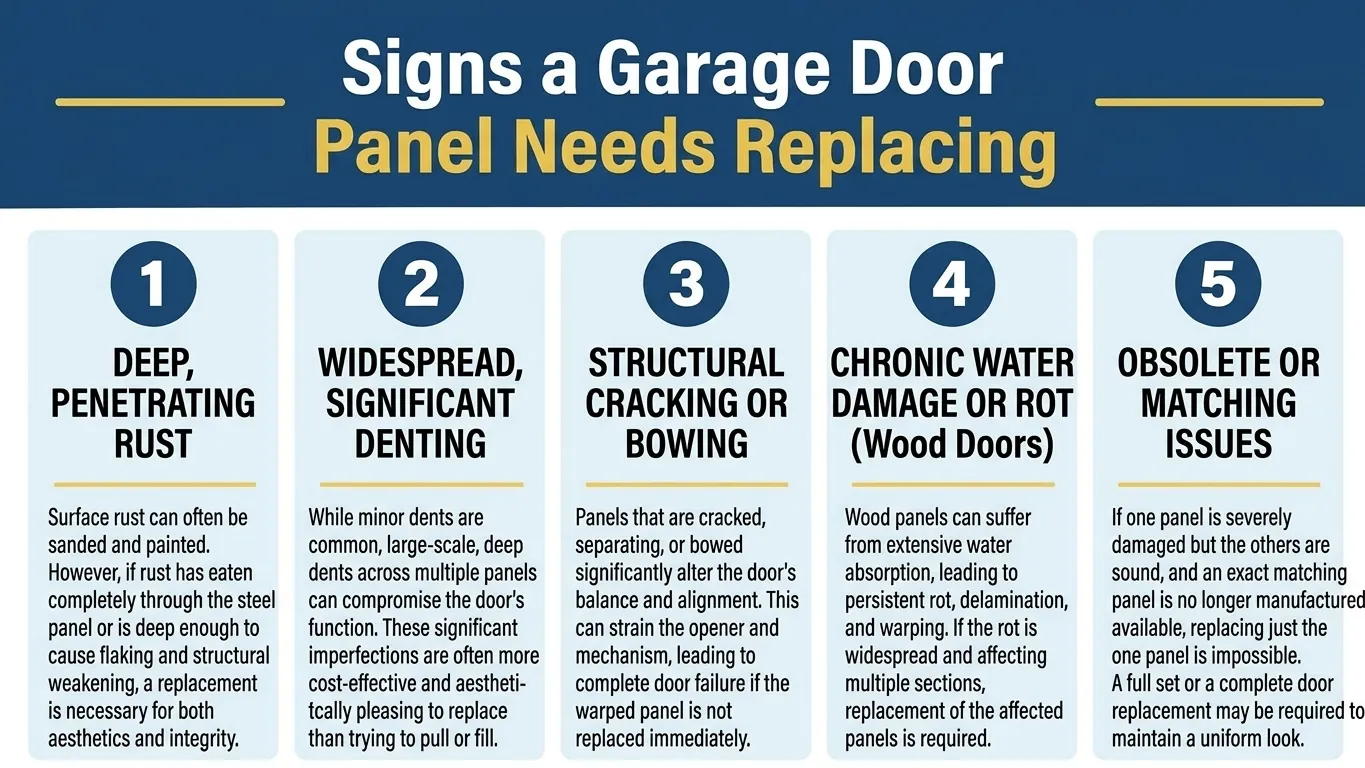
Cracks, deep dents, spreading rust, and warping rank among the clearest and most common signs a garage door panel needs replacing rather than a simple patch job. Ignoring these signs for too long often lets a single damaged panel cause lasting, more expensive damage to the rest of the door over time.
The right response to a damaged panel, whether a garage door panel replacement or a smaller repair, depends on which specific sign shows up and how far the damage has spread. This guide walks through each warning sign in detail, along with what it actually means for the door’s overall condition.
Key Takeaways
- Cracks that continue spreading rarely stop on their own without repair
- Deep dents can affect the door frame and overall track alignment
- Rust reaching the structural steel signals a panel beyond simple repair
- Gaps between panels often point to hardware or alignment problems
- Warping frequently requires an exact match panel rather than a quick fix
Common Signs a Garage Door Panel Needs Replacing
A garage door panel shows its age or damage through a handful of distinct warning signs, each pointing to a different underlying cause.
| Sign | What It Indicates | Recommended Action |
| Spreading cracks | Structural weakness in the panel material | Replace before the crack widens further |
| Deep dents | Possible frame or track misalignment | Inspect the frame, then replace if affected |
| Rust in structural steel | Compromised panel integrity | Replace to avoid further weakening |
| Gaps between panels | Hardware wear or panel misalignment | Replace the affected panel or section |
| Warping | Heat damage or manufacturing defect | Replace, since warping rarely reverses |
Structural damage such as cracking, rust, or warping requires professional repair or replacement, not surface-level maintenance.
Cracks Spreading Across the Panel Surface
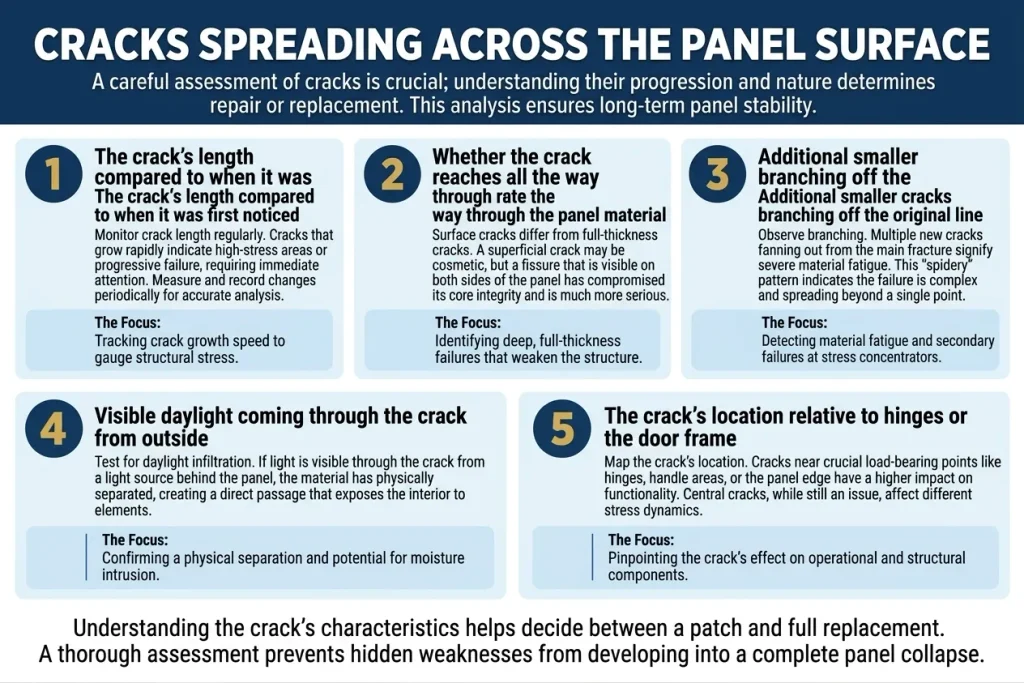
A crack that keeps expanding instead of staying the same size usually signals damage that will only worsen over time, especially without prompt attention.
A few specific checks reveal how far the crack has actually progressed:
- The crack’s length compared to when it was first noticed
- Whether the crack reaches all the way through the panel material
- Additional smaller cracks branching off the original line
- Visible daylight coming through the crack from outside
- The crack’s location relative to hinges or the door frame
Scheduling a garage door panel repair early, before the crack spreads further, often prevents the need for a larger replacement job later.
Dents Affecting the Door Frame or Track
A dent deep enough to touch the door frame or track often affects more than the panel’s surface appearance, extending into how the door operates.
Assessing the dent closely usually involves checking for the following:
- Whether the dent creates a visible gap along the track
- Any resistance felt when the door opens or closes near the dent
- Metal that has bent inward far enough to touch nearby hardware
- Scraping sounds occurring at the same point during each cycle
- Visible separation between the panel and its supporting frame
To find out how a professional determines whether the whole structure needs attention, read our guide on Can Garage Door Panels Be Replaced?, which walks through the full decision process from start to finish.
Rust Reaching the Structural Steel
Surface rust looks concerning, but rust that reaches the structural steel underneath signals that the panel is losing its actual strength.
Confirming rust has gone beyond the surface takes a closer look at:
- Flaking or crumbling metal visible along the rust patch
- A rough, pitted texture replacing the smooth original surface
- Rust spreading faster after recent rain or humid weather
- Weakness felt when pressing gently on the affected area
- Rust appearing on both sides of the same steel panel
To understand what typically causes this kind of structural damage and how it develops and spreads over time, read our guide on What Causes Garage Door Panel Damage?, which breaks down every common cause in detail.
Gaps Between the Panel and Its Neighbors
A gap forming between one panel and the panels beside it usually points to a hardware or alignment issue rather than the panel alone.
Narrowing down the cause of the gap starts with these details:
- The gap’s size and whether it changes as the door moves
- Visible daylight or airflow coming through the new gap
- Loose hinges or brackets near the location of the gap
- A new panel installed previously that never fit correctly
- Increased noise or vibration coming from the affected section
Tracing the gap back to loose hardware often lets a technician resolve it with a garage door installation adjustment instead of a full panel swap.
Warping That Affects Smooth Operation
A warped panel often creates visible waves or ripples along the surface that affect how smoothly the door operates.
Identifying warping as the real culprit often comes down to:
- Visible waves or ripples across the panel’s flat surface
- The door catching or dragging at the same point in the panel
- Uneven reflection of light across what should be a flat surface
- Difficulty finding a correct replacement panel due to the warp’s severity
- Heat exposure history, such as direct sun on that side of the door
To learn how a technician sources an exact match when warping requires a full swap, read our guide on How to Match a Replacement Panel to an Existing Door, which covers the entire matching process.
What to Do After Noticing These Signs
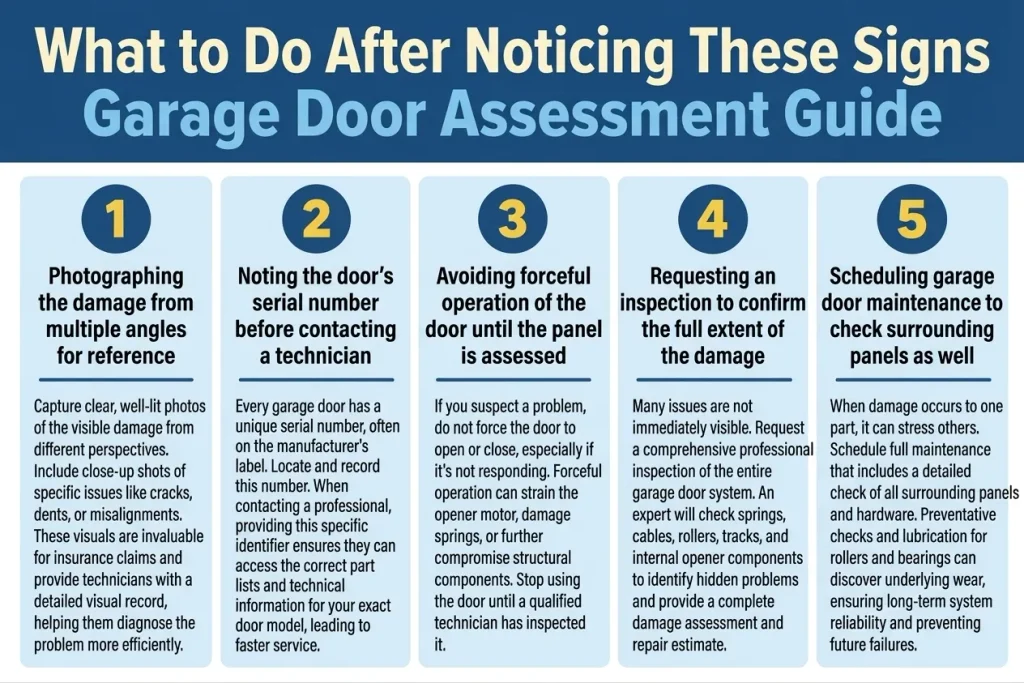
If you notice one or more of these signs early, take a clear, deliberate next step instead of waiting to see if the problem worsens on its own.
Moving through this process efficiently means covering these steps:
- Photographing the damage from multiple angles for reference
- Noting the door’s serial number before contacting a technician
- Avoiding forceful operation of the door until the panel is assessed
- Requesting an inspection to confirm the full extent of the damage
- Scheduling garage door maintenance to check surrounding panels as well
Responding promptly to these signs helps protect the rest of the door from the same problem, especially once one panel has already shown clear signs of wear.
Addressing a Damaged Panel Early Protects the Whole Door
Noticing a damaged panel early keeps a small, contained problem from reaching the door frame or nearby panels, especially once wear has already started. Addressing the issue promptly also keeps the total cost lower than waiting until a full door replacement is the only remaining option.
Alachua Door Company inspects every reported panel issue across Gainesville with the same careful attention before recommending a repair or full door replacement. Contact us or give us a call today, and let an experienced technician confirm what the damage means for the door’s long-term condition.
Frequently Asked Questions
Does one damaged panel always mean the whole door needs replacing?
A single panel can often be replaced on its own as long as the surrounding panels remain in good condition. Full replacement becomes necessary only when damage spreads across multiple panels or affects the door frame itself.
Can a small crack in a garage door panel get worse over time?
A small crack that continues expanding rather than staying stable usually indicates ongoing stress on the panel material. Left unaddressed, the crack typically spreads further and eventually requires replacing the damaged section entirely.
What does a gap between garage door panels usually mean?
A gap between panels often points to loose hardware, worn brackets, or a panel that was never installed correctly. Addressing the underlying hardware issue alongside the gap prevents the same problem from returning in the long run.
Is rust on a garage door panel always a sign of serious damage?
Surface rust alone is not always serious, but rust reaching the structural steel underneath signals real weakening of the panel. A technician can confirm how deep the rust has spread during a routine inspection.
Why does a warped panel need replacement instead of repair?
Warping typically results from heat exposure or a manufacturing defect, and warped material rarely returns to its original shape. Finding an exact replacement panel is a more reliable long-term solution.
How quickly should a damaged garage door panel be addressed?
Addressing a damaged panel soon after noticing the sign prevents the issue from spreading to the door frame or nearby panels. Waiting too long often increases both the extent of the damage and the eventual panel replacement costs.
Can a homeowner inspect a garage door panel for damage themselves?
Most homeowners can safely do a basic visual inspection for cracks, dents, or rust from a normal standing position. Leave testing the door’s balance or examining tension springs to a trained professional, given the safety risks involved.
What tools does a professional use to confirm panel damage?
A flashlight, a tape measure, and sometimes a level help a technician confirm the exact extent of damage during an inspection. These simple tools reveal issues that aren't always obvious at a quick glance.
Does the age of a garage door affect how panel damage is handled?
Older doors sometimes require more effort to source a matching panel, since some manufacturers discontinue certain colors and door model styles over time. A professional can recommend the closest available option through color matching when an exact original match is not possible.


